Imagine you’re comparing two packages of the same type of food.
One costs $2.50.
The other costs $4.00.
If your only question is:
“Which one costs less right now?”
the answer is simple.
The $2.50 product.
But if you’re asking:
“Which option will cost me less for what I actually need?”
you may need more information.
The lowest shelf price and the lowest overall cost aren’t always the same thing.
Shelf Price Tells You What You’ll Pay Today
The shelf price is important.
It tells you how much money you’ll need to purchase the product.
And sometimes that’s the information that matters most.
If you have $3 available for the purchase, a $4 product may not be a realistic option regardless of whether it offers a lower unit price.
That’s an important part of value literacy.
A product can offer more for each dollar and still require more dollars than someone can spend at that moment.
Affordability today and value over time are related, but they aren’t identical.
Package Size Changes the Comparison
Suppose you’re comparing:
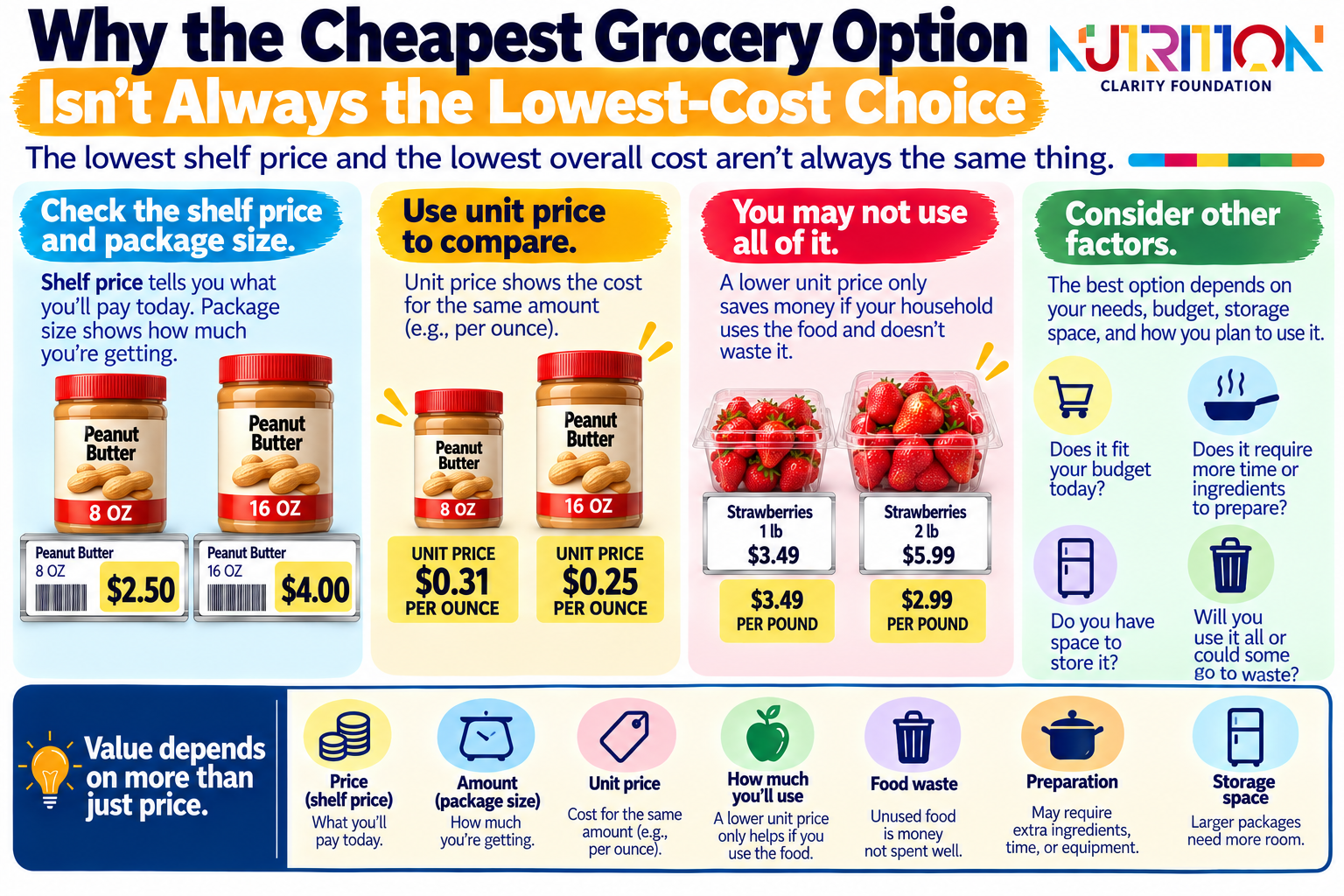
Product A: $2.50 for 8 ounces
Product B: $4.00 for 16 ounces
Product A costs less at checkout.
But Product B contains twice as much food.
If you regularly use the product and will use the entire package, the larger size may cost less for the amount you’re receiving.
That’s where unit price can help.
Product A costs about $0.31 per ounce.
Product B costs $0.25 per ounce.
The cheaper package has the higher cost per ounce.
That doesn’t automatically make Product B the better purchase.
It simply tells you something the shelf price alone didn’t show.
The Lowest Unit Price Isn’t Automatically the Answer Either
Now imagine the 16-ounce package has the lower unit price, but half of it usually goes unused.
Maybe the food spoils before your household finishes it.
Maybe you don’t have enough freezer or storage space.
Maybe you only need a small amount for one recipe.
If part of the larger package regularly gets thrown away, the lower unit price may not translate into lower household cost.
The amount you actually use matters.
This is why unit price is a comparison tool—not a command telling you which product to buy.
Food Waste Can Change the Value of a Purchase
A product only provides value if it serves a purpose in the household.
Consider fresh produce sold in two package sizes.
The larger package costs less per pound.
But if your household regularly uses only half before the rest spoils, the smaller package may result in less money being spent on food that goes uneaten.
For another household, the larger package may be used completely and offer excellent value.
The same product can represent different value depending on how it is used.
Preparation Can Add Other Costs
The price on the package isn’t always the only resource involved in using a food.
Preparation may require:
additional ingredients
cooking time
electricity or gas
kitchen equipment
storage
cleanup
planning ahead
Imagine two versions of a similar food.
One costs less but requires considerably more preparation.
The other costs more but can be prepared quickly.
For a household with enough time and the necessary equipment, the lower-priced option may work well.
For someone managing a long workday, caregiving responsibilities, or limited cooking facilities, the more convenient option may be more useful.
Cost isn’t always measured only in dollars.
Time and household resources can matter too.
Replacing an Unused Product Costs Money
Sometimes we buy the cheaper option and discover that nobody in the household likes it.
Then another product has to be purchased.
In that situation, the first purchase didn’t necessarily save money.
This doesn’t mean shoppers should always pay more for familiar brands.
Trying lower-cost alternatives can be a useful way to find products that work well for less.
It simply means whether the product actually gets used belongs in the value calculation.
Taste and household preferences have economic consequences when food goes uneaten.
Storage Can Affect What Makes Sense
Larger packages and bulk purchases often require somewhere to put them.
A household with a large pantry, freezer, or refrigerator may be able to store extra food easily.
Someone with limited cabinet space, a small refrigerator, shared housing, or limited freezer capacity may not.
Buying the largest package because it has the lowest unit price doesn’t help much if there is nowhere practical to store it.
Storage is another example of why value depends on circumstances.
Sometimes the Cheapest Option Really Is the Best Fit
None of this means you should avoid the least expensive product.
Sometimes the cheapest option does exactly what you need.
Maybe the package size is right.
Maybe your household likes it.
Maybe you’ll use all of it.
Maybe it fits today’s budget.
Maybe comparable products don’t offer enough additional value to justify spending more.
That’s a perfectly reasonable outcome.
Value literacy isn’t about finding reasons to spend more money.
It’s about understanding what you’re receiving for what you’re spending.
Ask What “Cost” Means for This Purchase
When a grocery decision matters enough to compare, you might consider:
What will I pay today?
How much product am I getting?
What is the unit price?
How much will my household realistically use?
Could part of this go to waste?
Does it require additional ingredients or preparation?
Do I have space to store it?
Does buying more now fit my current budget?
You won’t need to ask every question for every purchase.
Sometimes the choice will be obvious.
But when two products are difficult to compare, these questions can reveal differences that the shelf price doesn’t show.
Price Is Part of Value—Not the Whole Picture
The cheapest grocery product is the one with the lowest purchase price.
The lowest-cost option for your household can be more complicated.
Sometimes they’re the same product.
Sometimes they aren’t.
Understanding package size, unit price, household use, waste, preparation, and storage gives you more information for making that distinction.
The purpose isn’t to find one universally “best” product. It’s to understand what you’re paying for and whether that purchase works for the way your household actually lives.
That’s value literacy in everyday grocery shopping.
Nutrition Clarity Takeaway
Continue Learning with Nutrition Clarity Foundation
Food decisions are part of everyday life. Explore practical, easy-to-understand resources designed to help you better understand food information and make informed decisions with greater confidence.