Have you ever reached for something you buy regularly and thought:
“Wait. Wasn’t this cheaper last time?”
Sometimes it was.
Food prices change.
A product may cost more than it did a few months ago.
A sale you regularly relied on may disappear.
A store brand may suddenly cost almost as much as another brand.
A package may change size.
And a grocery routine that once worked comfortably within your budget may need to be reconsidered.
When prices change, grocery decisions can change too.
That doesn’t mean you have to relearn how to shop.
The comparison skills you already use can help you adjust.
Your Usual Choice May Not Always Offer the Same Value
Most people develop grocery routines.
You know which bread you usually buy.
Which cereal.
Which frozen vegetables.
Which pasta sauce.
Which package size.
Routine can make grocery shopping faster because you don’t have to reconsider every product every time.
But when prices change, the value relationship between products can change too.
Suppose your usual product was $3.49 and a comparable product was $4.29.
Your usual option clearly cost less.
Later, your product rises to $4.19 while the other remains $4.29.
Now the difference is only ten cents.
That doesn’t mean you need to switch.
It simply means the comparison is different than it used to be.
Look at the Current Price, Not the Price You Remember
We often carry an idea of what something “normally costs.”
That mental reference can be useful.
But grocery prices don’t stay fixed.
When the price of a frequently purchased product changes, look at what’s actually happening on the shelf today.
You might check:
the current shelf price
nearby alternatives
package sizes
unit prices
current promotions
store-brand options
Sometimes your usual product will still make sense.
Sometimes another option may now offer similar value for less.
The point is to compare the choices that exist now.
Package Size Can Change Along With Price
Price isn’t the only number worth watching.
Package quantity matters too.
Imagine a product stays around the same price but the package becomes smaller.
If you only look at the shelf price, the change may be easy to miss.
Unit price can help reveal differences in how much you’re paying for the amount you’re receiving.
For example:
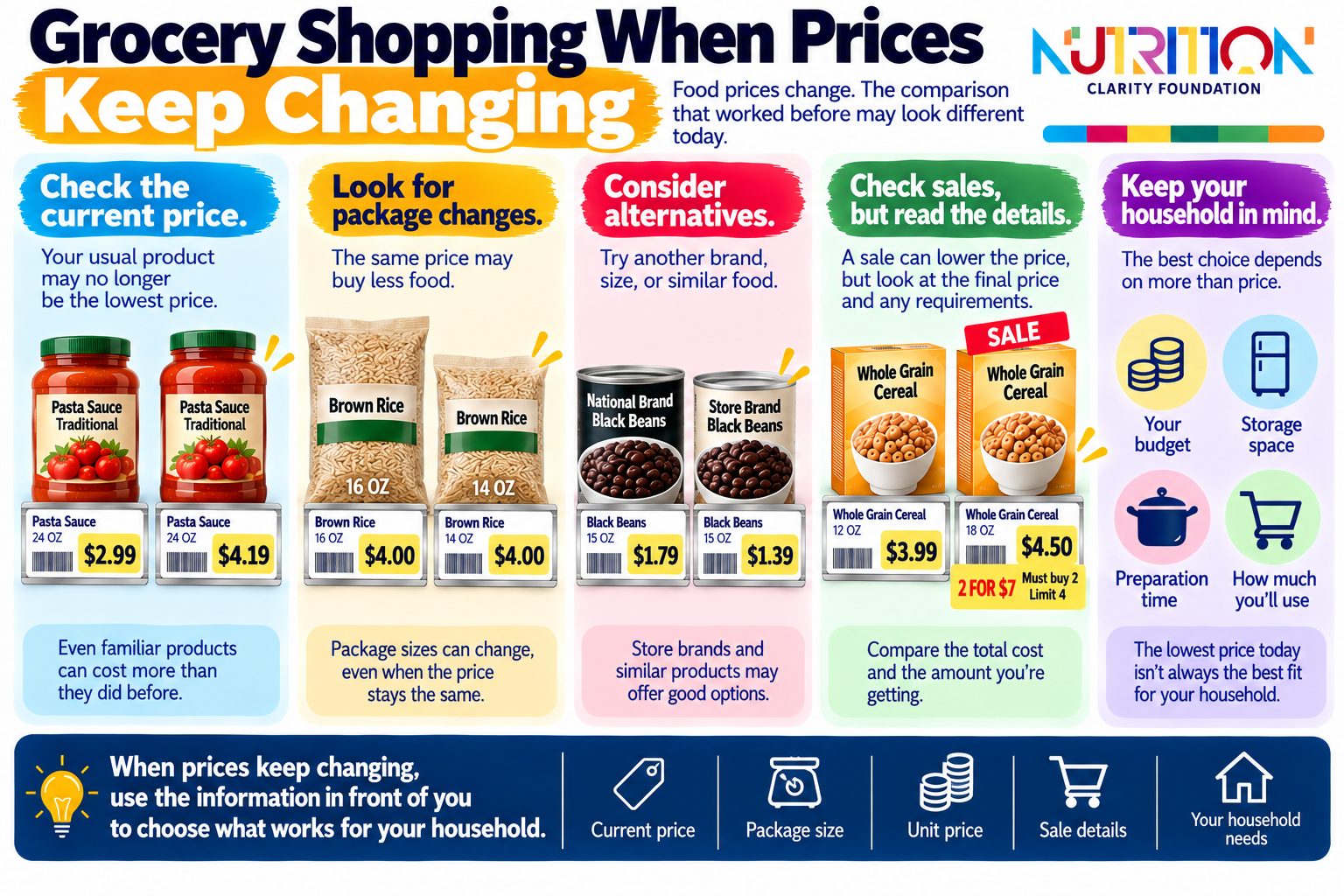
Product A: $4.00 for 16 ounces
Unit price: $0.25 per ounce
Later:
Product A: $4.00 for 14 ounces
Unit price: about $0.29 per ounce
The checkout price didn’t change.
The cost per ounce did.
This is one reason package size and unit price can provide useful context when grocery prices feel unpredictable.
Substitutions Can Create More Options
When a familiar product becomes more expensive, substitution is one possible response.
That might mean choosing:
another brand
a store brand
a different package size
a similar ingredient
another form of the same food
a product currently on sale
A substitution doesn’t have to be permanent.
Maybe your preferred product goes back on sale next week.
Maybe you try the alternative and like it.
Maybe you don’t.
Food literacy gives you tools for evaluating unfamiliar options when your usual choice no longer works the way it once did.
Compare What Matters to You
Switching products doesn’t require comparing every number on the package.
If your main concern is price, start there.
If you’re comparing package sizes, check unit price.
If a particular nutrient matters for your decision, compare that nutrient on the Nutrition Facts label.
If you’re curious about how two products differ, look at their ingredient lists.
If preparation time matters, consider that too.
A useful comparison starts with the question you’re actually trying to answer.
You don’t need to analyze everything simply because you’re considering a different product.
Sales Can Help—but Compare the Final Price
Changing prices can make promotions especially noticeable.
A sale may make a product more affordable than usual.
But a sale sign doesn’t automatically mean the product is the lowest-priced or lowest-unit-cost option available.
Check:
What will I actually pay?
How much product am I getting?
Do I have to buy multiple items to receive the discount?
Is another comparable option still less expensive?
A promotion is information.
You can decide whether it offers value for the purchase you’re making.
Different Stores May Offer Different Tradeoffs
Prices can also vary between retailers.
One store may have lower prices on some products while another has better prices on others.
But store choice isn’t only about the shelf price.
Transportation matters.
Distance matters.
Time matters.
Delivery fees may matter.
Product availability matters.
A store with a slightly lower price isn’t necessarily less expensive for a household if getting there requires additional transportation costs or considerable extra time.
Food costs exist within the larger reality of how people access food.
A Changing Budget Can Change the Comparison Too
Sometimes grocery prices stay the same while something else changes.
Rent increases.
Transportation costs rise.
Income changes.
A child starts school.
A new household expense appears.
Money available for groceries can change even when the price on the shelf doesn’t.
That can shift what someone prioritizes.
A shopper may pay closer attention to shelf price.
Choose smaller packages.
Switch brands.
Purchase certain items less frequently.
Or prioritize foods used across multiple meals.
These decisions reflect changing circumstances.
Flexibility Is a Food-Literacy Skill
Food literacy isn’t only knowing how to read a label.
It’s also knowing how to use information when circumstances change.
Prices will change.
Products will change.
Stores will change.
Households will change.
The exact grocery list that works today may not work forever.
Skills such as reading shelf labels, understanding unit price, comparing package sizes, evaluating substitutions, and using food labels can travel with you even when the products themselves change.
You Don’t Have to Reevaluate the Entire Store
Price changes don’t mean every grocery trip needs to become a research project.
Focus on the products where the difference matters.
Maybe you notice one regular purchase has increased significantly.
Compare that item.
Maybe a package looks smaller.
Check the quantity.
Maybe a sale catches your attention.
Look at the final price.
You can use food information selectively.
The purpose of food literacy is to make information more useful—not to make grocery shopping more complicated.
The Best Value Can Change
There may not be one grocery product that permanently represents the best value.
Prices change.
Promotions change.
Package sizes change.
Availability changes.
And your household changes too.
Knowing how to compare products means you aren’t completely dependent on one brand, one package size, or one familiar price.
You have tools for looking at the options in front of you and understanding what they offer.
When grocery prices keep changing, the answer isn’t memorizing what to buy. It’s knowing how to compare your options when the situation changes.
That skill can remain useful long after today’s prices are gone.
Nutrition Clarity Takeaway
Continue Learning with Nutrition Clarity Foundation
Food decisions are part of everyday life. Explore practical, easy-to-understand resources designed to help you better understand food information and make informed decisions with greater confidence.