You walk into the grocery store expecting to grab the same product you usually buy.
Then it's gone.
Maybe it's sold out. Maybe the store stopped carrying it. Maybe the price changed enough that you're reconsidering it. Or maybe you're shopping somewhere different and your usual brand isn't there at all.
Suddenly, a decision you normally make without much thought becomes another comparison.
The good news is that you don't necessarily have to start from scratch.
What you already know about your usual product can help you decide what to look for next.
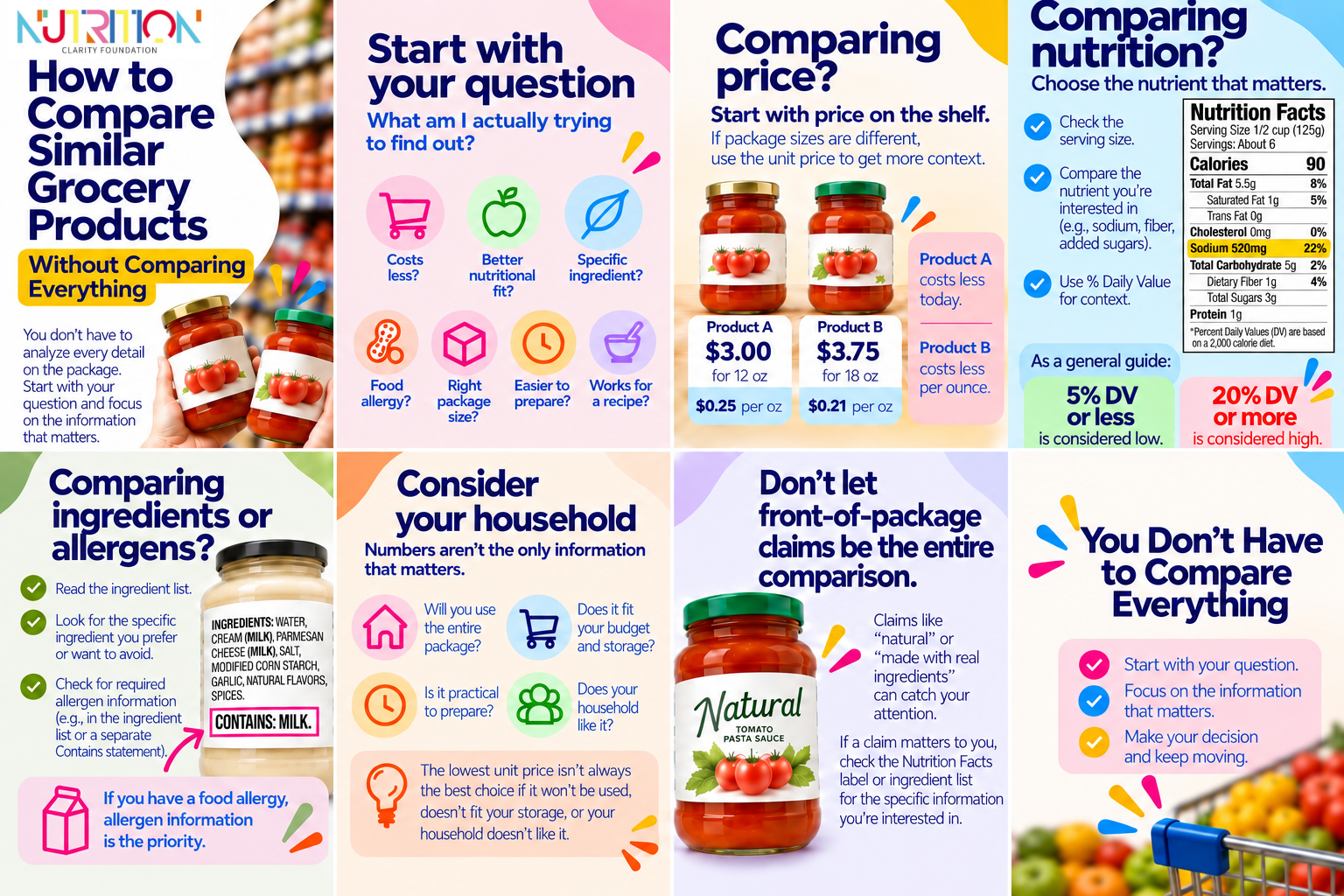
Start With Your Question
Before comparing two products, ask:
What am I actually trying to find out?
Maybe you want to know which one:
costs less
offers more for the price
contains more or less of a particular nutrient
has a certain ingredient
fits a food-allergy need
comes in the amount your household needs
requires less preparation
works better for a particular recipe
Those are different questions.
And they require different information.
If you’re comparing price, you may not need to analyze every nutrient.
If you’re checking for an allergen, the fact that one product costs 10 cents less may not be the most important part of the comparison.
Your question helps narrow your attention.
If You’re Comparing Price, Start With Price
Suppose you’re choosing between two similar products and your priority today is staying within your grocery budget.
Start with the shelf price.
If the packages contain similar amounts, that may give you enough information.
If the package sizes are different, unit price can provide more context.
For example:
Product A: $3.00 for 12 ounces
Product B: $3.75 for 18 ounces
Product A has the lower checkout price.
Product B costs less per ounce.
Now you know two different things:
Which requires less money today.
And which provides more product for each dollar.
Which one matters more depends on your situation.
If You’re Comparing Nutrition, Pick the Nutrient That Matters
Nutrition Facts labels contain a lot of information.
You don’t necessarily need to compare every line.
Maybe you’re specifically looking at sodium.
Compare sodium.
Maybe dietary fiber is what matters for this purchase.
Compare fiber.
Maybe you’re looking at added sugars.
Focus there.
The FDA’s % Daily Value can also provide context for how much a nutrient contributes to a daily diet.
As a general guide:
5% Daily Value or less per serving is considered low.
20% Daily Value or more per serving is considered high.
Before comparing nutrients, check the serving sizes too.
Two products may appear different partly because the nutrition information is based on different serving amounts.
If You’re Comparing Ingredients, Know What You’re Looking For
Ingredient lists can be long.
That doesn’t mean you have to research every unfamiliar word before choosing a product.
Maybe you’re checking whether a particular ingredient is present.
Maybe you want to understand what gives two similar products different textures.
Maybe you’re looking for an ingredient you prefer or avoid.
Maybe you’re simply curious about why the products are different.
Ingredients are generally listed in descending order by weight.
That can help you understand how a product is formulated.
If you encounter an unfamiliar ingredient that matters to your decision, you can look it up using a credible source.
The goal isn’t to memorize every possible food ingredient.
It’s to know where to look when you have a question.
Food-Allergy Comparisons Require Specific Information
If you’re checking a product because of a food allergy, the comparison becomes more specific.
FDA-regulated packaged foods must identify major food allergens as required by federal labeling law.
That information may appear in the ingredient list or in a separate Contains statement.
In this situation, allergen information may be far more important than comparing price, package size, or a front-of-package claim.
This is another example of why the purpose of the comparison matters.
Different questions require attention to different parts of the package.
Don’t Let Front-of-Package Claims Become the Entire Comparison
One product says:
“Natural.”
Another says:
“Good source of fiber.”
Another highlights a specific vitamin.
Those statements may catch your attention.
But they aren’t necessarily comparing the same characteristic.
If a claim matters to you, ask what information you actually want from it.
If you’re interested in fiber, check the Nutrition Facts label.
If you’re curious about ingredients, look at the ingredient list.
If you want to understand what a particular labeling term means, look for reliable information about how that term is defined or regulated.
A front-of-package statement can give you a reason to look closer.
It doesn’t have to make the entire decision.
Similar Products Can Be Different in More Than One Way
Imagine you’re comparing two jars of pasta sauce.
One costs less.
The other has a lower unit price because the jar is larger.
Their sodium amounts differ.
Their added sugar amounts differ.
Their ingredient lists aren’t identical.
One is on sale.
Which one wins?
There isn’t enough information to answer that question.
Because we haven’t established what matters for the decision.
If your priority is spending the least today, one product may make sense.
If you’re comparing sodium, another piece of information becomes relevant.
If your household strongly prefers one flavor and will actually use it, that matters too.
The existence of differences doesn’t mean every difference needs to determine your choice.
You Can Compare in Layers
One way to simplify grocery comparisons is to work in layers.
Start with your most important question.
If that gives you an answer, you may be done.
If the products are still close, look at another factor.
For example:
First: Which fits my budget?
Both do.
Next: Which package size works for my household?
Both would work.
Next: Is there a nutrient I want to compare?
One difference matters to you.
Decision made.
You didn’t need to compare every ingredient, every nutrient, every claim, and every number.
You used enough information to answer your question.
Household Use Belongs in the Comparison
Numbers aren’t the only information that matters.
Suppose one product has the lowest unit price, but your household doesn’t like it.
Or the larger package won’t fit in your available storage.
Or you know half of it will probably go unused.
Or another option takes significantly less time to prepare.
Those circumstances can change the value of the product.
Food comparisons happen within real households.
The information on the label helps you understand the product.
Your circumstances help you understand whether it works for you.
Sometimes Preference Is Enough
Not every grocery decision needs a technical explanation.
Maybe two products fit your budget.
Both work for what you’re preparing.
Neither presents an issue you’re specifically concerned about.
And you simply like one better.
That’s information too.
Taste and preference are legitimate parts of food decisions.
Food literacy gives you tools for understanding your options.
It doesn’t require you to turn every purchase into an optimization problem.
You Don’t Have to Find the “Perfect” Product
Comparing food products can become difficult when the question changes from:
“Which one works for what I need?”
to:
“Which one is objectively the best?”
There may not be one answer.
One product can cost less.
Another can have a lower unit price.
Another may contain more of a nutrient you’re interested in.
Another may be easier to prepare.
Another may simply taste better to your household.
Different characteristics can matter in different situations.
The purpose of comparison isn’t necessarily to identify a universal winner.
It’s to understand the differences that matter for the decision you’re making.
Make the Information Work for You
Food packages contain a lot of information because people may need that information for different reasons.
You don’t need all of it every time.
Start with the question.
Then find the part of the package or shelf that helps answer it.
Price question? Look at price and, when useful, unit price.
Nutrition question? Use the Nutrition Facts label.
Ingredient question? Check the ingredient list.
Allergen question? Look for required allergen information.
Quantity question? Check package size.
Household question? Consider how the product will actually be used.
That’s a much more manageable way to compare products.
Food literacy isn’t about analyzing everything. It’s about knowing which information can help you answer the question in front of you.
Sometimes that’s one number.
Sometimes it’s one section of a label.
And sometimes you’ve already got enough information to make the decision and keep moving.
Nutrition Clarity Takeaway
Continue Learning with Nutrition Clarity Foundation
Food decisions are part of everyday life. Explore practical, easy-to-understand resources designed to help you better understand food information and make informed decisions with greater confidence.