SALE.
2 FOR $6.
BUY ONE, GET ONE.
LIMITED-TIME PRICE.
Sale signs are designed to get our attention.
And sometimes a sale really does offer a useful opportunity to spend less.
But seeing the word “sale” doesn’t automatically tell you whether a product is the better deal for the purchase you’re making.
To figure that out, you may need a little more information.
Start With the Actual Price
A sale price tells you what the product costs during the promotion.
But the word “sale” by itself doesn’t tell you how that price compares with your other options.
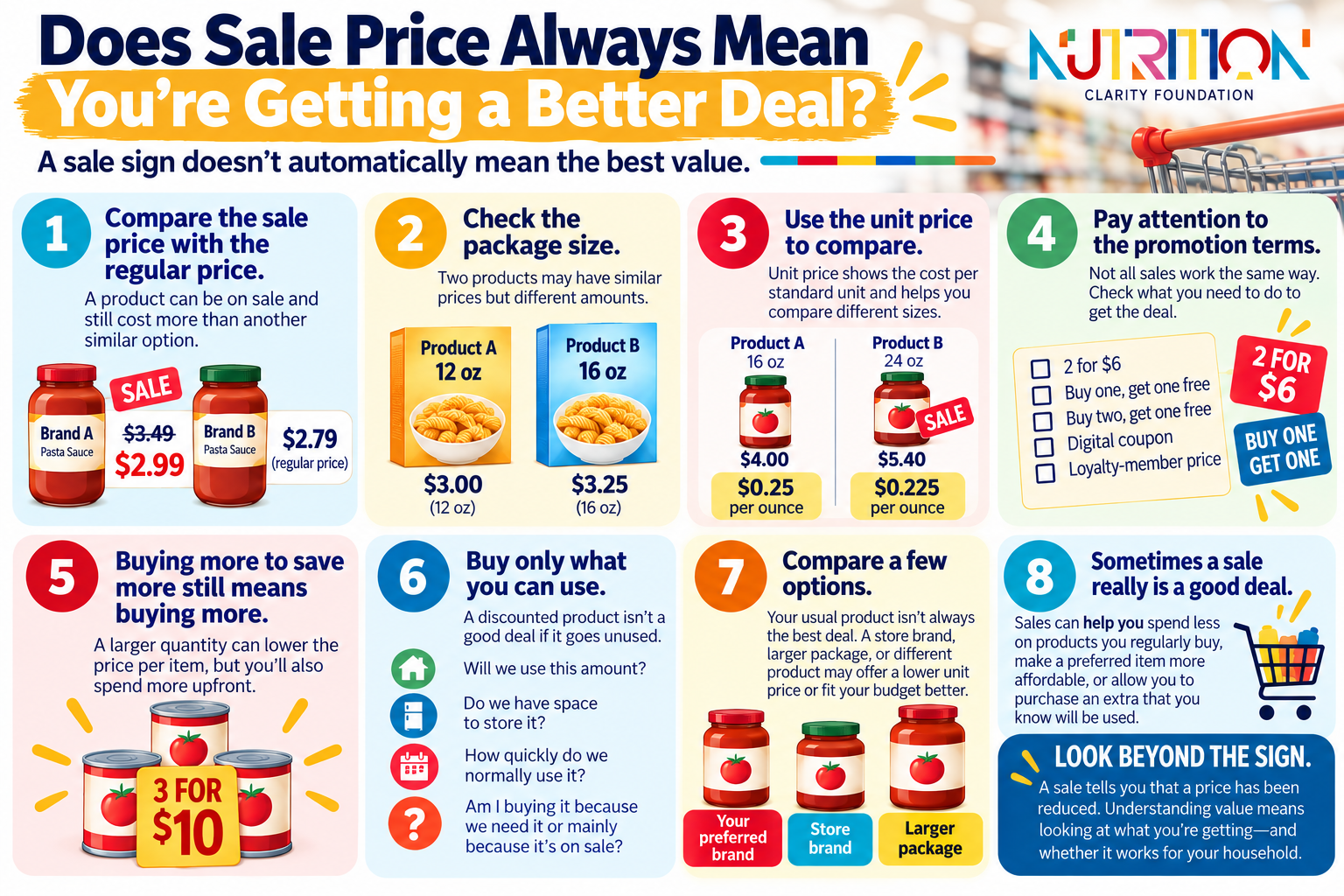
Imagine one brand of pasta sauce is normally $3.49 and is on sale for $2.99.
A similar product from another brand is regularly $2.79.
The first product is discounted.
The second product still costs less.
That doesn’t automatically make either product the better choice. You may prefer one brand, package size, ingredient list, or product for another reason.
It simply shows why discounted and lowest price don’t always mean the same thing.
Check the Package Size
Two products can have similar prices while containing different amounts.
Suppose:
Product A: $3.00 for 12 ounces
Product B: $3.25 for 16 ounces
Product A has the lower shelf price.
But Product B gives you more product for the additional 25 cents.
If Product A goes on sale for $2.75, the comparison changes again.
This is where package size becomes important.
A sale can lower the price without necessarily making the product less expensive for the amount you’re getting.
Unit Price Can Help With the Comparison
Unit price shows the cost of a product based on a standard unit of measurement, such as an ounce, pound, quart, or individual item.
It can be especially useful when products come in different package sizes.
For example:
Product A: $4.00 for 16 ounces
Unit price: $0.25 per ounce
Product B: Sale price of $5.40 for 24 ounces
Unit price: $0.225 per ounce
Product B costs more at checkout.
But it costs less per ounce.
That doesn’t automatically mean you should buy Product B.
It means the unit price has given you another piece of information about the value you’re receiving for the amount purchased.
Pay Attention to the Terms of the Sale
Not every promotion works the same way.
A sign might say:
2 for $6
Does that mean one costs $3?
Or do you have to purchase two to receive the promotional price?
Store policies and promotion terms can differ.
The same applies to offers such as:
buy one, get one free
buy two, get one free
spend a certain amount and receive a discount
loyalty-member pricing
digital coupon offers
quantity discounts
Before adding extra items to your cart, check what the promotion actually requires.
The deal may only make sense if the required quantity works for your household.
Buying More to Save More Still Means Buying More
Promotions sometimes encourage shoppers to purchase a larger quantity.
That can work well when the household regularly uses the product.
But imagine you normally buy one container for $4.
A promotion offers three for $10.
Buying three reduces the average price to about $3.33 each.
That’s a lower price per container.
You’re also spending $10 instead of $4 today.
If you’ll use all three and have room in your budget, that may offer good value.
If the additional products aren’t needed, the lower per-item price may matter less than the additional money spent.
Both pieces of information belong in the decision.
A Deal Isn’t Valuable If the Product Goes Unused
Price matters.
Use matters too.
A deeply discounted product may not offer much household value if part of it spoils, expires, or sits unused.
Before purchasing extra because something is on sale, you might consider:
Will we actually use this amount?
Do we have somewhere to store it?
How quickly do we normally use this product?
Am I buying it because we need it or mainly because it’s discounted?
There isn’t one correct answer.
These questions simply help connect the promotion to your household’s actual needs.
Your Usual Product Isn’t Automatically the Best Sale Comparison
Sales can also be a good time to compare options you might normally overlook.
Your preferred brand may be discounted.
A store brand might still cost less.
A larger package may offer a lower unit price.
A smaller package may fit your budget better today.
A different product may work just as well for what you’re making.
You don’t need to compare every product on the shelf.
But when the price difference matters, checking one or two alternatives can give you useful context.
Sometimes the Sale Really Is a Good Deal
Looking closely at a promotion doesn’t mean sales aren’t useful.
They absolutely can be.
A sale may reduce the cost of something your household regularly buys.
It may make a preferred product more affordable.
It may allow you to purchase an extra item that you know will be used.
It may provide a lower unit price than comparable options.
The point isn’t to distrust every sale sign.
It’s to understand what the sale is actually offering.
Look Beyond the Sign
A sale price is one piece of information.
When you want a fuller picture, you can also consider:
the actual price you’ll pay
the regular price
package size
unit price
quantity requirements
how much you need
how much you will realistically use
what fits your current grocery budget
Sometimes the sale product will come out ahead.
Sometimes another option will.
And sometimes paying slightly more for the amount you actually need will make more sense than buying extra just to receive a discount.
A sale tells you that a price has been promoted or reduced. Understanding value requires looking at what you’re actually getting—and whether it works for your household.
Nutrition Clarity Takeaway
Continue Learning with Nutrition Clarity Foundation
Food decisions are part of everyday life. Explore practical, easy-to-understand resources designed to help you better understand food information and make informed decisions with greater confidence.