You’re standing in a grocery aisle comparing two products.
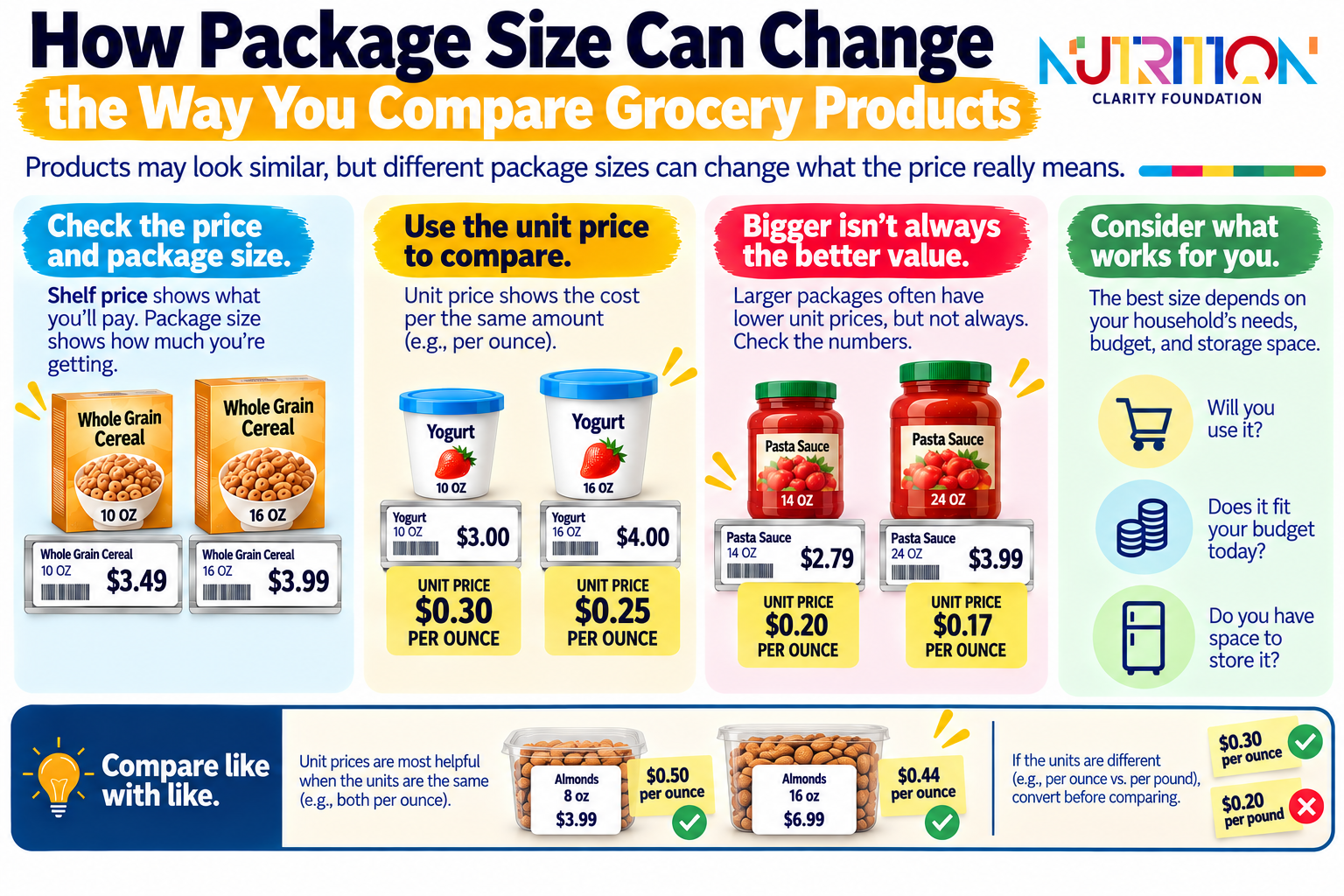
One costs $3.49.
The other costs $3.99.
At first glance, the $3.49 option appears less expensive.
Then you look at the packages.
One contains 10 ounces.
The other contains 16.
Now the comparison looks different.
Shelf price tells you what you’ll pay for the package. Package size tells you how much you’re getting for that price.
When products come in different sizes, looking at both can give you a clearer picture of what you’re comparing.
Similar Products Don’t Always Come in Similar Sizes
Package sizes can vary considerably, even among products sitting next to one another.
One cereal box might contain 12 ounces while another contains 16.
One container of yogurt might hold 24 ounces while another contains 32.
One bag of rice might weigh two pounds while another weighs five.
If you’re looking only at the shelf price, it can be easy to miss those differences.
A product that costs slightly more may contain considerably more.
A product that costs less may also contain less.
Neither fact automatically determines which one you should buy.
It simply changes what the prices mean.
Unit Price Can Make Different Sizes Easier to Compare
When package sizes are different, unit price can help put products on the same basis.
Unit price shows how much a product costs per standard unit, such as:
per ounce
per pound
per quart
per item
Imagine:
Product A: $3.00 for 10 ounces
Unit price: $0.30 per ounce
Product B: $4.00 for 16 ounces
Unit price: $0.25 per ounce
Product A costs less at checkout.
Product B costs less per ounce.
Those are both true.
The useful question is which piece of information matters for the decision you’re making.
Lower Shelf Price and Lower Unit Price Answer Different Questions
This distinction is important.
Shelf price answers:
How much money will I spend to purchase this package today?
Unit price answers:
How much am I paying for a standard amount of this product?
Sometimes the same product wins both comparisons.
Sometimes it doesn’t.
If your priority is staying under a certain grocery total today, shelf price may matter more.
If you’re comparing how much product you’re receiving for your money, unit price may be especially useful.
Understanding both gives you more context.
The Bigger Package Isn’t Automatically the Better Value
Larger packages often have lower unit prices.
But not always.
That’s why checking can be useful.
A smaller package might be on sale.
A store brand may have a different pricing structure.
A medium package might actually have the lowest unit price.
Packaging and promotions can change the comparison.
The words family size, value size, or economy size on a package also don’t replace the actual numbers.
If value matters for the purchase, the price, quantity, and unit price can tell you more.
How Much You’ll Use Matters Too
Suppose the 32-ounce package has the lowest unit price.
That information can be useful.
Now another question enters the picture:
Will your household use 32 ounces?
If the product is something your household uses regularly, the larger package may work well.
If part of it is likely to spoil or remain unused, a smaller package may make more sense even with a higher unit price.
Package size affects value partly because households use products differently.
Storage Can Change the Decision
A package also has to fit somewhere.
Large containers require pantry, refrigerator, or freezer space.
Bulk packages may need to be divided or stored after opening.
For a household with plenty of storage, that may not be an issue.
For someone with a small refrigerator, limited cabinet space, shared kitchen storage, or no freezer space, package size can become a practical limitation.
The lowest unit price doesn’t remove those realities.
Package Size Can Affect How Much You Spend Today
Buying more product can reduce the cost per unit while increasing the amount you pay at checkout.
Consider:
Smaller package: $4
Larger package: $7
The $7 package may provide more product for each dollar.
You still need $7 to purchase it.
For a household managing a limited grocery budget, the additional $3 may need to go toward something else.
This is one reason value and affordability aren’t always the same thing.
A product can provide strong value per unit and still not fit today’s budget.
Compare Like With Like When You Can
Unit pricing is most helpful when you’re comparing similar products measured in the same way.
If one shelf label shows price per ounce and another shows price per pound, you’ll need to convert the units before making a direct comparison.
You may also encounter products where the comparison isn’t straightforward because the foods are packaged, prepared, or measured differently.
You don’t have to force every grocery decision into a mathematical comparison.
Use unit price when it provides useful information.
Package Size Can Change More Than Price
You don’t need to calculate every grocery decision.
Sometimes the package you want is obvious.
Sometimes the price difference is too small to matter to you.
Sometimes preference, convenience, availability, or another factor makes the decision simple.
But when you’re trying to understand why two similar products have different prices, package size is a useful place to look.
Check the amount in each package.
Look at the unit price if it’s available.
Consider how much you’ll actually use.
Think about today’s grocery budget and the storage you have available.
The largest package doesn’t automatically offer the best value, and the lowest shelf price doesn’t automatically mean the lowest cost for the amount you’re buying.
Package size gives you another piece of information for understanding the difference.
And once you know what you’re comparing, you can decide which option makes sense for your household.
Use the Information That Matters for the Purchase
You don’t need to calculate every grocery decision.
Sometimes the package you want is obvious.
Sometimes the price difference is too small to matter to you.
Sometimes preference, convenience, availability, or another factor makes the decision simple.
But when you’re trying to understand why two similar products have different prices, package size is a useful place to look.
Check the amount in each package.
Look at the unit price if it’s available.
Consider how much you’ll actually use.
Think about today’s grocery budget and the storage you have available.
The largest package doesn’t automatically offer the best value, and the lowest shelf price doesn’t automatically mean the lowest cost for the amount you’re buying.
Package size gives you another piece of information for understanding the difference.
And once you know what you’re comparing, you can decide which option makes sense for your household.
Nutrition Clarity Takeaway
Continue Learning with Nutrition Clarity Foundation
Food decisions are part of everyday life. Explore practical, easy-to-understand resources designed to help you better understand food information and make informed decisions with greater confidence.