Have you ever turned over a food package, looked at the ingredient list, and noticed a name you didn’t recognize?
Maybe it was xanthan gum, citric acid, soy lecithin, or calcium propionate.
You might recognize some ingredients immediately while others leave you wondering what they are and why they’re included.
Many ingredients are added to foods for specific purposes. Some help preserve freshness. Others influence texture, flavor, color, or how ingredients behave when mixed together.
Understanding these functions can make ingredient lists easier to interpret.
What Is a Food Additive?
In everyday conversation, people often use the term food additive to describe an ingredient added to a food during manufacturing.
Under U.S. food law, however, the term has a more specific regulatory meaning.
The Food and Drug Administration (FDA) defines food additives according to how substances are intended to be used and whether they affect a food’s composition or characteristics.
Certain substances, including ingredients that are generally recognized as safe (GRAS) under their intended conditions of use, are excluded from the legal definition of a food additive.
This means that not every ingredient added during food manufacturing is legally classified as a food additive.
For consumers reading a package, a useful starting point is understanding what an ingredient does in the product.
Why Are Ingredients Added to Food?
Food manufacturers use ingredients for many reasons.
Some ingredients help maintain product quality during storage and transportation. Others help create a particular texture, flavor, appearance, or consistency.
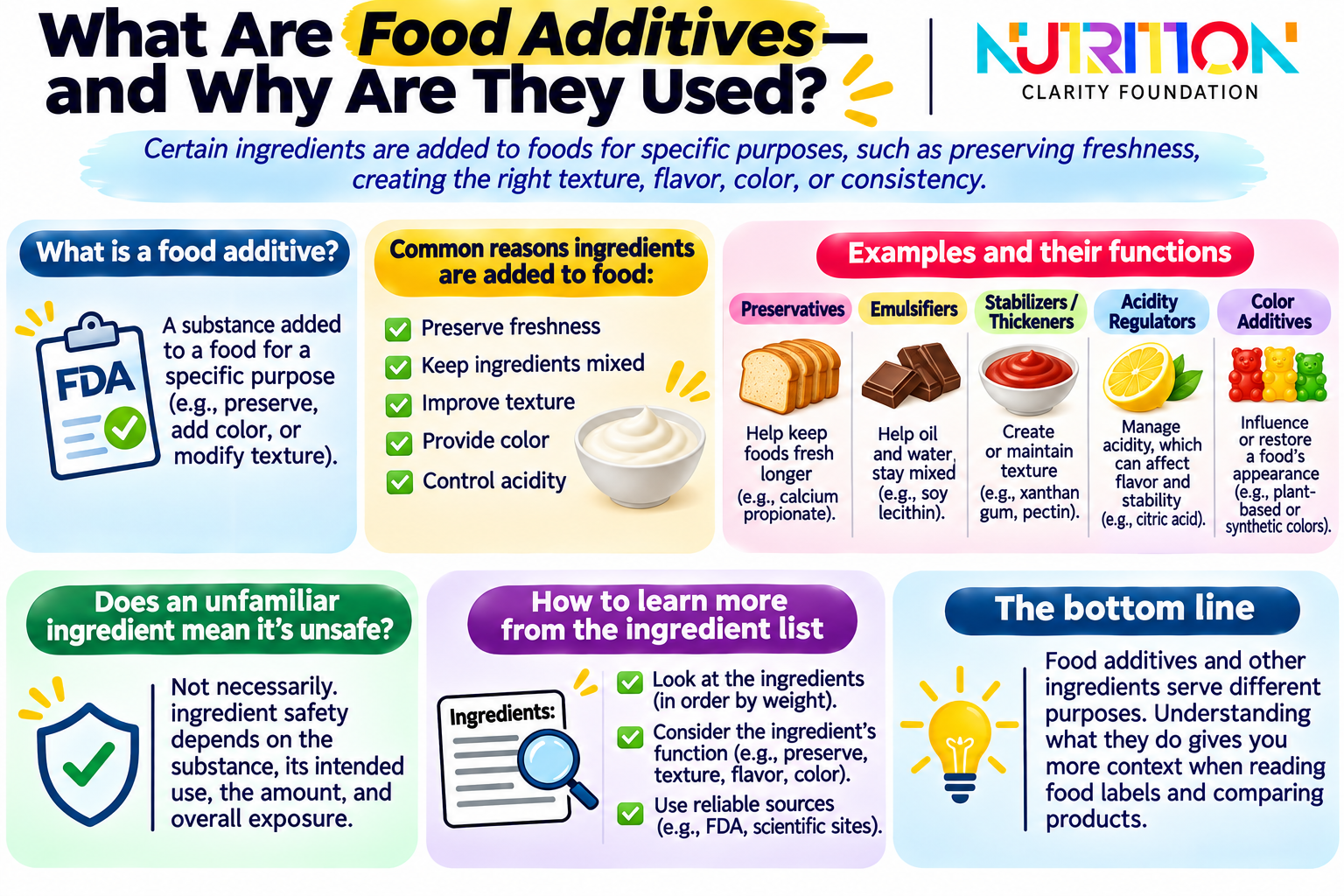
According to the FDA, common functions include preserving freshness, preventing separation, improving texture, providing color, and controlling acidity.
Let’s look at a few examples.
Preservatives: Helping Foods Maintain Quality
Preservatives are used to slow certain changes that can occur in foods over time.
Some help limit the growth of microorganisms that cause spoilage. Others help prevent fats and oils from developing undesirable flavors or odors.
For example:
Calcium propionate may be used in baked goods to help prevent mold growth.
Sodium benzoate may be used in certain beverages, sauces, and other products to help control microbial growth.
Ascorbic acid, also known as vitamin C, can function as an antioxidant in some foods.
These ingredients don’t all work in exactly the same way.
Their functions depend on the particular ingredient, food product, and conditions in which they’re used.
Emulsifiers: Helping Ingredients Stay Mixed
Have you ever noticed how oil and water naturally separate?
Some food products contain ingredients that don’t easily remain mixed together.
Emulsifiers help those ingredients combine or stay dispersed.
For example, soy lecithin may be used in chocolate and other foods to help manage how ingredients mix and behave.
Other emulsifiers are used in products such as salad dressings, frozen desserts, and baked goods.
Their role is connected to the product’s structure and consistency.
Stabilizers and Thickeners: Creating Texture
Texture is another reason ingredients may be added to foods.
Some products need to remain thick, smooth, or consistent during storage and use.
Ingredients such as xanthan gum, pectin, and guar gum can help influence texture.
You might find them in products such as sauces, dressings, jams, and frozen desserts.
These ingredients can serve different functions depending on the product.
For example, an ingredient that helps thicken a sauce may be used differently in a frozen dessert.
Understanding the function gives you more context than the ingredient name alone.
Acidity Regulators: Managing a Food’s Acidity
Some ingredients help control how acidic or alkaline a food is.
Acidity can influence flavor, product stability, and the conditions under which certain microorganisms grow.
Citric acid, for example, may be used to adjust acidity in beverages, sauces, and other products.
Citric acid also occurs naturally in citrus fruits.
The fact that an ingredient can occur naturally doesn’t necessarily tell us why it has been included in a particular packaged food.
Its function depends on how it is being used.
Color Additives: Influencing Appearance
Color additives are used for several reasons.
They may help restore color affected by processing or storage, create a consistent appearance, or provide a particular color to a product.
Color additives can come from different sources, including plant-derived materials and synthetically produced substances.
The FDA regulates color additives separately and establishes requirements for their permitted uses.
As with other ingredients, understanding the purpose of a color additive is different from evaluating its safety for a particular use.
Does an Unfamiliar Ingredient Mean Something Is Unsafe?
An unfamiliar ingredient name doesn’t automatically tell us whether an ingredient is safe or unsafe.
Ingredient safety involves more than recognizing a name.
Factors such as the substance itself, its intended use, the amount present, and potential exposure are relevant to safety evaluations.
In the United States, food additives generally require FDA authorization before they can be used, unless a legal exclusion applies.
Ingredients classified as GRAS must meet applicable requirements for that status.
Regulatory decisions and scientific understanding can also change as new evidence becomes available.
If you want to learn more about a particular ingredient, credible regulatory and scientific sources can help you understand its function, permitted uses, and available safety information.
How Can You Learn More From an Ingredient List?
Ingredient lists provide useful information about what goes into packaged foods.
For foods subject to FDA ingredient-labeling requirements, ingredients generally appear in descending order by weight.
This means the ingredient present in the greatest amount by weight is listed first.
However, the ingredient list doesn’t usually tell you the exact amount of every ingredient.
It also doesn’t necessarily explain why each ingredient was used.
When you encounter something unfamiliar, consider these questions:
What is the ingredient?
What function does it serve in this type of food?
Is it used for preservation, texture, flavor, color, or another purpose?
Where can I find reliable information about it?
These questions can help you move from simply recognizing ingredient names toward understanding their roles.
Understanding Ingredients Builds Food Literacy
Food ingredient lists can contain familiar names, technical terms, and ingredients that serve several different purposes.
Learning about those functions helps make the information more understandable.
You don’t need to memorize every ingredient or research every food package you purchase.
You can begin with the ingredients you’re curious about and build your understanding over time.
The more you understand what ingredients do, the more context you have when interpreting food labels and comparing products.
That’s an important part of food literacy: learning how to find, understand, and use food information in everyday life.
Nutrition Clarity Takeaway
Continue Learning with Nutrition Clarity Foundation
Food decisions are part of everyday life. Explore practical, easy-to-understand resources designed to help you better understand food information and make informed decisions with greater confidence.