Pick up two similar products at the grocery store and turn them around.
They may look almost identical from the front.
But their Nutrition Facts labels can tell a different story.
One may contain more sodium. Another may have more fiber. The calories might differ. One may contain added sugars while another doesn’t.
Why?
Because foods that belong to the same general category aren’t necessarily made the same way.
Understanding where those differences come from can make comparing products much easier.
Start With Serving Size
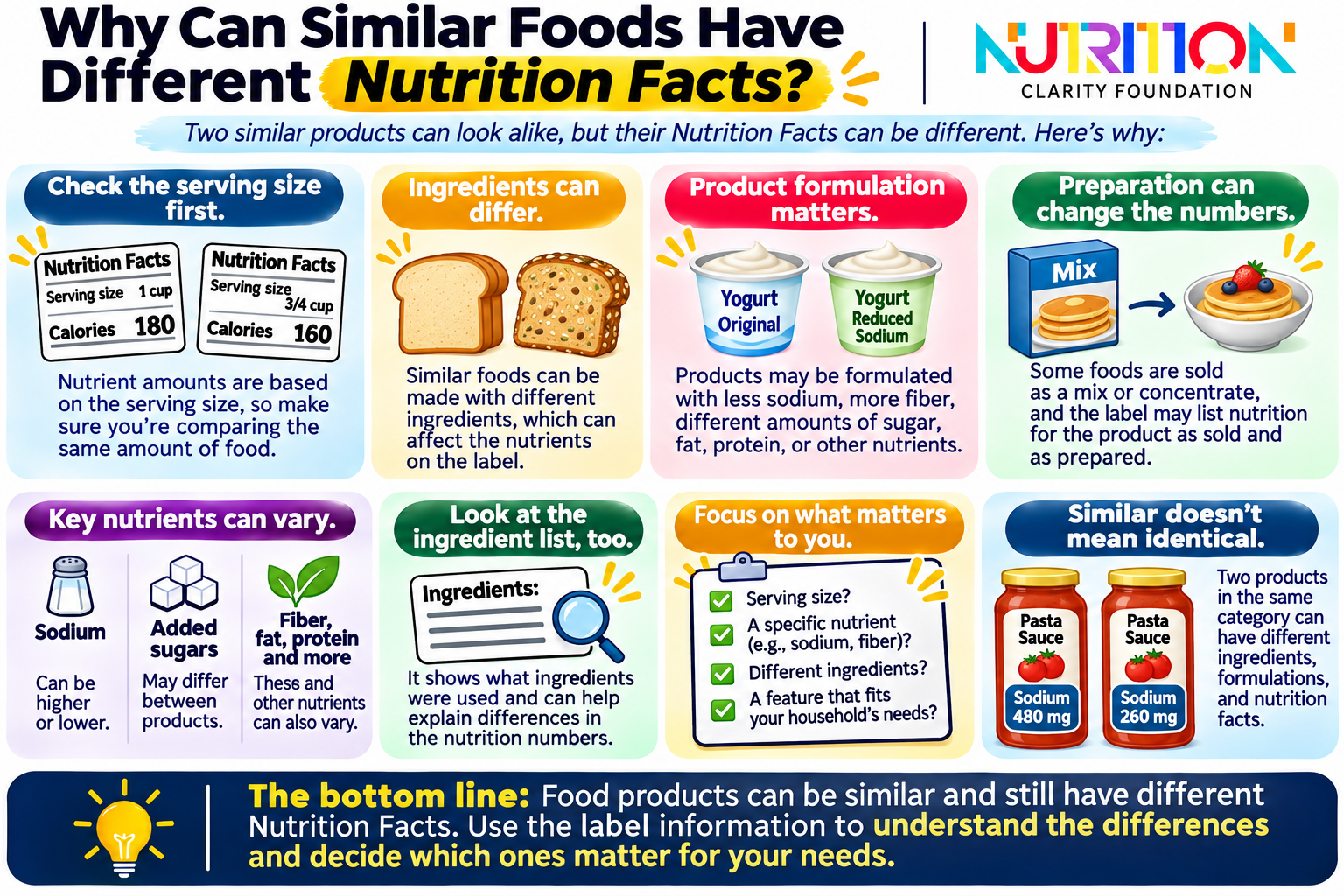
Before comparing any numbers on two Nutrition Facts labels, look at the serving size.
This matters because the nutrient amounts on the label correspond to the listed serving.
If two products use different serving sizes, comparing the numbers directly can give you an incomplete picture.
Imagine one product lists nutrition information for 1 cup while another lists it for 3/4 cup.
Seeing 180 calories on one label and 160 on the other doesn’t automatically tell you which contains fewer calories for the same amount of food.
The portions being described are different.
The same issue can affect comparisons of sodium, fiber, added sugars, protein, and other nutrients.
Before comparing the numbers, make sure you understand how much food each label is describing.
Similar Foods Can Have Different Ingredients
Two products can serve a similar purpose while being made with different ingredients.
Consider two loaves of bread.
One might contain different types or proportions of flour, sweeteners, oils, seeds, or other ingredients than the other.
Two pasta sauces may use different amounts of tomatoes, oils, sweeteners, salt, vegetables, herbs, or other ingredients.
Those differences can affect the nutrients reported on the Nutrition Facts label.
The product category may be the same.
The recipe doesn’t have to be.
Product Formulation Matters
Food manufacturers develop products to meet different purposes.
One version of a product might be formulated with less sodium.
Another might contain additional fiber.
One cereal may contain more added sugar than another.
A yogurt may differ in fat content, added sugars, protein, or other nutrients depending on how it is formulated.
Even products made by the same company can have different Nutrition Facts if they are different varieties.
Words such as “original,” “light,” “reduced sodium,” “whole grain,” or different flavors may indicate that you’re looking at different formulations.
The Nutrition Facts label lets you see what those differences mean nutritionally.
Preparation Can Change the Numbers You See
How a food is sold or intended to be prepared can also affect what appears on a label.
Some foods are ready to eat.
Others are concentrated, dried, frozen, or designed to be prepared with additional ingredients.
For example, a packaged mix might provide nutrition information for the product as packaged and may also provide information for the food as prepared according to package directions.
When comparing products, check what the numbers are actually describing.
Are you looking at the food as sold?
As prepared?
With another ingredient added?
That context matters.
Sodium Can Vary Considerably
Sodium is one nutrient where shoppers may notice significant differences between similar packaged foods.
Products such as soups, sauces, breads, frozen meals, canned vegetables, and snack foods can vary in sodium depending on their formulation.
That’s why simply knowing the type of food doesn’t necessarily tell you how much sodium it contains.
If sodium is something you’re comparing, look directly at the Nutrition Facts label.
You can check both the amount in milligrams and the % Daily Value (%DV).
The FDA’s general guide is that 5% DV or less per serving is considered low and 20% DV or more per serving is considered high for an individual nutrient.
That guide can help put the number into context.
Added Sugars Can Differ Too
Added sugars are another area where similar products may vary.
Added sugars include sugars added during processing as well as certain other sugars identified under FDA labeling rules.
The Nutrition Facts label lists Total Sugars and separately identifies how much of that amount comes from Added Sugars.
Two similar foods may therefore contain similar amounts of total sugar while differing in added sugar—or they may differ in both.
If added sugars matter for the comparison you’re making, the label gives you a specific place to look.
Fiber, Fat, Protein, and Other Nutrients May Vary
Differences aren’t limited to sodium and sugar.
Depending on the food, similar products can vary in:
dietary fiber
total fat
saturated fat
protein
vitamins and minerals
calories
You don’t necessarily need to compare every nutrient.
Think about why you’re comparing the products in the first place.
If you’re interested in fiber, focus there.
If you’re comparing sodium, look at sodium.
If you’re simply trying to understand how two products differ, you might look at several parts of the label.
The purpose of the comparison can determine which information deserves your attention.
Don’t Forget the Ingredient List
The Nutrition Facts label tells you about nutrients.
The ingredient list tells you something different: what ingredients were used to make the food.
Looking at both can provide more context.
If two products have different amounts of fiber, for example, their ingredient lists may help you understand how their formulations differ.
If one contains added sugars and another doesn’t, the ingredient list can provide additional information about the ingredients used.
Neither section replaces the other.
They answer different questions.
You Don’t Have to Compare Everything
Food packages contain a lot of information.
Comparing every number, ingredient, claim, price, and package detail every time you shop would quickly become overwhelming.
Instead, start with what matters for the decision you’re making.
You might ask:
Are the serving sizes comparable?
Which nutrient am I actually interested in?
Are the products made with different ingredients?
Does one product offer something that matters more for my household?
Sometimes the differences will matter to you.
Sometimes they won’t.
Similar Doesn’t Mean Identical
Two products can sit beside each other on the shelf, serve the same general purpose, and still be nutritionally different.
That isn’t necessarily surprising once you remember that each product has its own formulation, ingredients, serving information, and intended use.
The Nutrition Facts label gives you a way to see those differences.
And you don’t need to determine which product is universally “better.”
You can use the information to understand how the products differ and decide which differences matter for the choice you’re making.
That’s what food literacy helps make possible.
Nutrition Clarity Takeaway
Continue Learning with Nutrition Clarity Foundation
Food decisions are part of everyday life. Explore practical, easy-to-understand resources designed to help you better understand food information and make informed decisions with greater confidence.