“Convenient” can sometimes sound like a criticism when we’re talking about food.
A convenient food may be described as the shortcut.
The easier option.
The thing someone chooses because they didn’t cook something from scratch.
But convenience can represent something much more important in everyday life.
It can mean having dinner ready before the next responsibility begins.
It can mean being able to prepare food with the equipment available.
It can mean carrying groceries home more easily.
It can mean having something available when time, energy, transportation, or household circumstances make other options difficult.
Convenience isn’t separate from food decisions. For many households, it’s one of the things that makes a food decision workable.
Convenience Can Mean Different Things
There isn’t one type of convenient food.
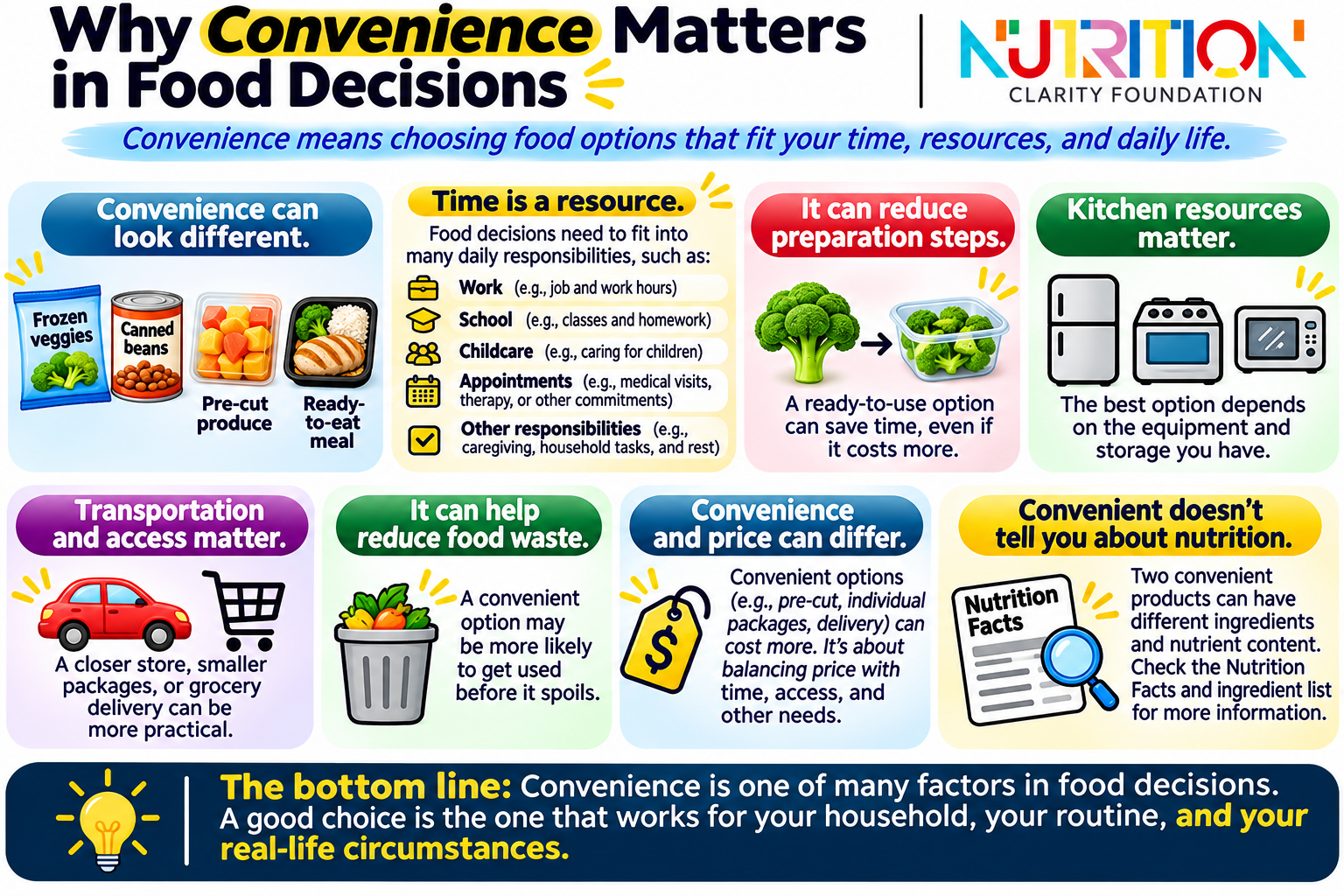
Convenience might mean:
a frozen vegetable that doesn’t require washing or chopping
canned beans instead of dried beans that require soaking and longer cooking
pre-cut produce
individually packaged items
a ready-to-eat meal
grocery delivery
a product available at the closest store
ingredients that can be prepared quickly
foods that require little cleanup
something that can be packed and taken somewhere
What feels convenient depends on the person and the situation.
A product that saves one household time might not be useful to another.
Time Is a Resource
Food preparation requires time.
So does grocery shopping.
Planning a meal, traveling to a store, comparing products, preparing ingredients, cooking, serving food, cleaning up, and storing leftovers can all take time.
People are fitting those tasks around the rest of their lives.
Work.
School.
Childcare.
Caregiving.
Appointments.
Transportation.
Rest.
Household responsibilities.
That doesn’t mean people don’t value food preparation.
It means time is one of the resources involved in making it happen.
A product that reduces preparation time can therefore offer a form of value that isn’t visible in the shelf price.
Convenience Can Reduce Preparation Steps
Imagine two versions of the same vegetable.
One is whole and needs to be washed, trimmed, and chopped.
The other is already washed and cut.
The whole vegetable may cost less.
The prepared version may save several steps.
Which is the better choice?
There isn’t enough information to answer that for everyone.
Someone with more available time may prefer the lower-priced option.
Someone trying to prepare dinner quickly between responsibilities may decide that paying more for fewer preparation steps is worthwhile.
The products are offering different kinds of value.
Kitchen Resources Matter Too
Food advice sometimes assumes everyone has access to the same kitchen setup.
That’s not always the case.
People may have different access to:
refrigerators and freezers
ovens and stovetops
microwaves
cooking utensils
storage containers
counter space
pantry space
Housing circumstances can also affect how much food someone can store or prepare at once.
A food that is inexpensive but requires equipment someone doesn’t have may not be a realistic option.
Convenience can partly mean choosing foods that work with the resources actually available.
Transportation Can Make Convenience More Important
Convenience can begin before someone enters the kitchen.
If grocery shopping requires walking, public transportation, arranging a ride, or coordinating several errands at once, the location of a store can matter.
Package size can matter.
Weight can matter.
How often someone needs to return to the store can matter.
Someone might shop at a closer store even when another retailer has lower prices.
Another person may choose shelf-stable foods that reduce the need for frequent trips.
Someone else may use grocery delivery when transportation is difficult.
These decisions involve convenience, but they also involve access.
Convenience Can Help Reduce Food Waste
Sometimes convenience affects whether a food actually gets used.
A whole ingredient may cost less while requiring preparation that repeatedly gets postponed.
A prepared version may cost more but get eaten before it spoils.
For another household, the whole ingredient may be used easily and the additional cost of the prepared version may not offer much value.
The important question isn’t whether one format is always better.
It’s whether the food works within the household’s routine.
Food that gets purchased and never used has a different value than food that fits naturally into how a household eats.
Convenience and Price Can Pull in Different Directions
Convenience sometimes costs more.
Pre-cut produce may have a higher price than whole produce.
Individual packages may cost more per ounce than a larger package.
Delivery may involve fees.
Ready-to-eat products may cost more than ingredients prepared at home.
Those differences matter.
At the same time, price is not the only resource being managed.
A household may be balancing money with time, transportation, preparation, storage, energy, and other responsibilities.
Understanding the tradeoff allows the person making the decision to determine what matters most in that situation.
Convenient Doesn’t Automatically Tell You About Nutrition
The word “convenient” describes how easy or practical something may be to obtain, prepare, store, or use.
It doesn’t tell you everything about the food itself.
Two convenient products can have very different ingredients and Nutrition Facts.
Two foods requiring more preparation can also be nutritionally different from one another.
If you want nutrition information, the Nutrition Facts label can provide it.
If you want ingredient information, the ingredient list can provide it.
If you want to understand value, price, unit price, package size, and household use may all be relevant.
Convenience is another part of the picture.
Different Days Can Require Different Solutions
Even within the same household, convenience may matter differently from one day to another.
On a weekend, someone may have time to cook a meal that takes an hour.
On a busy weekday, 15 minutes may be all that’s available.
A household may cook from scratch sometimes, use prepared ingredients other times, and rely on ready-to-eat foods on especially busy days.
Those decisions don’t have to contradict each other.
They respond to different circumstances.
Food Decisions Have to Fit Into Life
Food information can help us understand what we’re buying.
Price information helps us understand cost.
Nutrition Facts help us understand nutrients.
Ingredient lists help us understand what goes into packaged foods.
And our everyday circumstances help us determine how those pieces of information fit into an actual decision.
Convenience belongs in that conversation.
A food option can only be useful if it realistically works for the person or household expected to use it.
Recognizing that gives us a more complete—and more human—way to understand everyday food decisions.
Nutrition Clarity Takeaway
Continue Learning with Nutrition Clarity Foundation
Food decisions are part of everyday life. Explore practical, easy-to-understand resources designed to help you better understand food information and make informed decisions with greater confidence.