You’ve probably seen phrases like:
“Fortified with vitamin D.”
“Calcium-fortified.”
“With added vitamins and minerals.”
They can appear on cereals, beverages, grain products, and other foods.
But what does it actually mean when a food is fortified?
In simple terms, fortification involves adding nutrients to a food.
Usually, those nutrients are vitamins or minerals.
Understanding why they’re added—and how to find more information about them—can make this part of food labeling easier to interpret.
Why Are Nutrients Added to Foods?
Vitamins and minerals may be added to foods for different reasons.
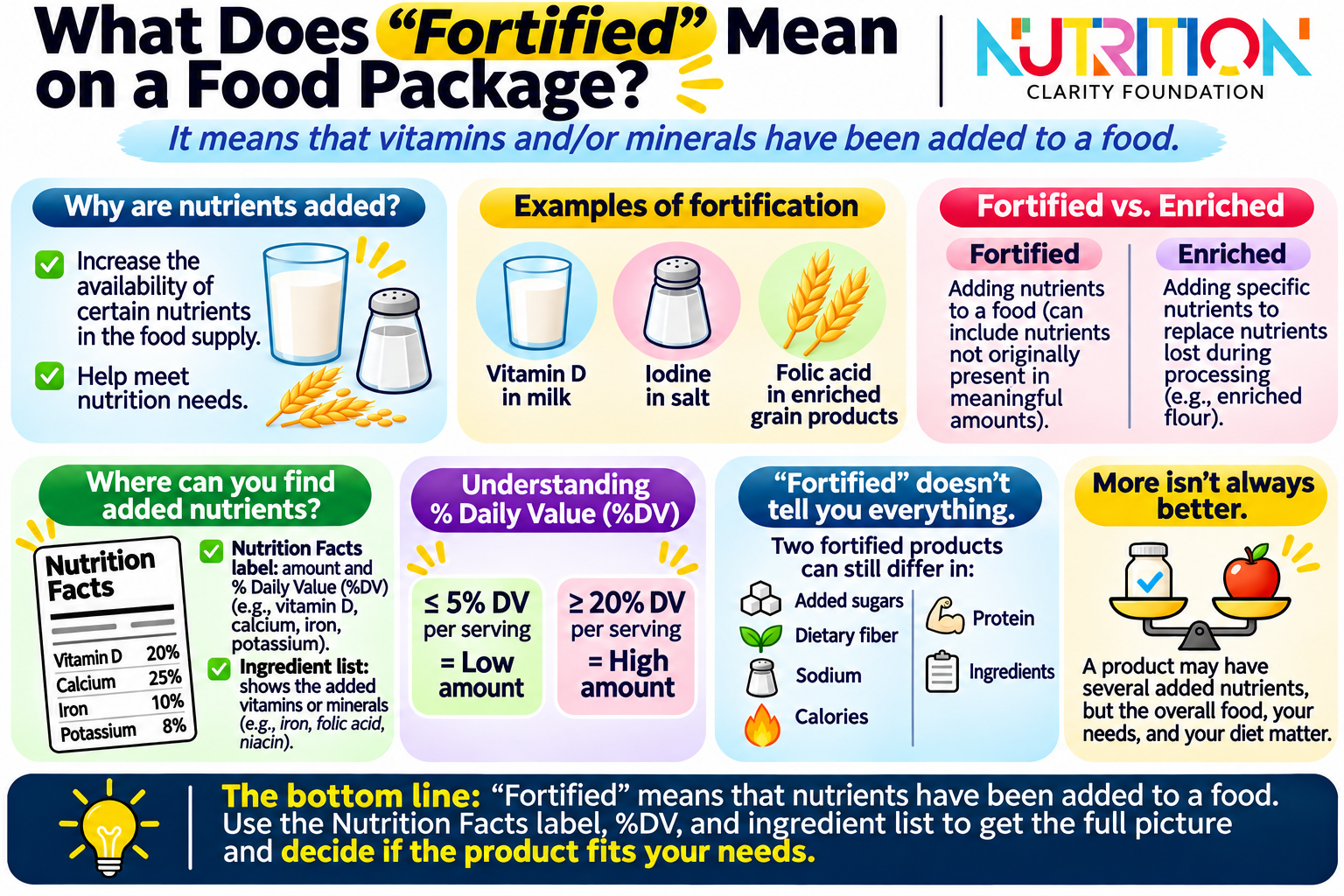
Fortification has been used as a public-health strategy to increase the availability of certain nutrients in the food supply.
One well-known example is vitamin D being added to milk.
Another is iodine being added to salt.
Folic acid fortification of enriched cereal grain products is another major example in the United States.
Nutrients may also be added to individual products as part of their formulation.
The fact that a nutrient has been added tells you something about the product.
It doesn’t necessarily tell you everything about its overall nutritional content.
Fortification and Enrichment Aren’t Exactly the Same Thing
The words fortified and enriched are sometimes used as though they mean the same thing.
They’re related, but they aren’t identical concepts.
Enrichment generally refers to adding certain nutrients to a food to replace nutrients lost during processing.
Refined grain products are a common example.
When grains are refined, portions of the grain are removed. Federal standards specify nutrients that must be present for certain grain products to be labeled enriched.
Fortification is a broader concept involving adding nutrients to foods, including nutrients that may not have originally been present in meaningful amounts.
So when you see enriched flour and vitamin D-fortified milk, you’re looking at two different examples of nutrients being added to foods.
Where Can You See Added Nutrients?
The front of a package may call attention to a particular vitamin or mineral.
But you don’t have to stop there.
The Nutrition Facts label provides information about certain vitamins and minerals in the product.
Current U.S. Nutrition Facts labels generally require information for:
vitamin D
calcium
iron
potassium
Other vitamins and minerals may also appear under certain circumstances.
The label provides both the amount and the % Daily Value (%DV) for listed vitamins and minerals.
That gives you more context than a front-of-package statement alone.
Check the Ingredient List Too
The ingredient list can provide another piece of the picture.
Ingredients are generally listed in descending order by weight.
Depending on the product, you may see the names of vitamins or minerals that have been added.
For example, an ingredient list might include forms of:
iron
folic acid
niacin
riboflavin
thiamin
vitamin D
calcium
The exact names can vary depending on the nutrient source used.
You don’t have to memorize them.
If you’re curious about an unfamiliar ingredient, you can look it up using a credible source and learn what role it serves.
“Fortified” Doesn’t Tell You Everything About the Food
Imagine two breakfast cereals.
Both are fortified with vitamins and minerals.
Their Nutrition Facts can still differ in many other ways.
They may contain different amounts of:
added sugars
dietary fiber
sodium
protein
calories
Their ingredient lists may also be different.
And their prices, package sizes, flavors, and usefulness to a household may differ.
Knowing that a food is fortified gives you information about added nutrients.
It doesn’t automatically tell you whether the entire product is the right choice for you.
Why Does the Amount Matter?
Simply knowing that a food contains a nutrient doesn’t tell you how much it provides.
That’s where the Nutrition Facts label can help.
Suppose two products both mention calcium.
One might provide a smaller percentage of the Daily Value per serving while another provides considerably more.
The FDA provides a general guide for interpreting % Daily Value:
5% DV or less per serving is considered low.
20% DV or more per serving is considered high.
That doesn’t mean every food needs to be high or low in a particular nutrient.
It gives you a reference point for understanding the amount listed.
More Isn’t Automatically Better
It’s easy to see a package advertising several vitamins and minerals and assume that more added nutrients automatically make the product better.
Food decisions are more complicated than that.
Nutrients have different functions and recommended intake levels.
People also consume nutrients from many foods and, in some cases, supplements.
A fortified product should therefore be understood in context rather than judged only by how many vitamins or minerals appear on the package.
The Nutrition Facts label can help you see what the product actually provides per serving.
Fortification Is One Piece of Food Information
A food package contains different types of information.
“Fortified” tells you something specific: nutrients have been added.
The Nutrition Facts label can tell you how much of certain nutrients the food contains.
The ingredient list can tell you what ingredients were used.
The price and package size can tell you something about cost and value.
Your household circumstances help determine whether the product works for you.
These pieces of information don’t compete with one another.
They answer different questions.
Understanding the Words Helps You Use the Label
Food packages contain terms that can sound familiar even when their exact meaning isn’t clear.
Fortified is one of them.
Once you understand what the term is communicating, you can decide whether you want more information.
You can turn to the Nutrition Facts label.
Look at the % Daily Value.
Review the ingredient list.
Compare another product.
Or simply recognize what the term means and continue shopping.
Food literacy isn’t about memorizing every label term. It’s about understanding enough to know what information you’re looking at—and where to go when you want to learn more.
Nutrition Clarity Takeaway
Continue Learning with Nutrition Clarity Foundation
Food decisions are part of everyday life. Explore practical, easy-to-understand resources designed to help you better understand food information and make informed decisions with greater confidence.