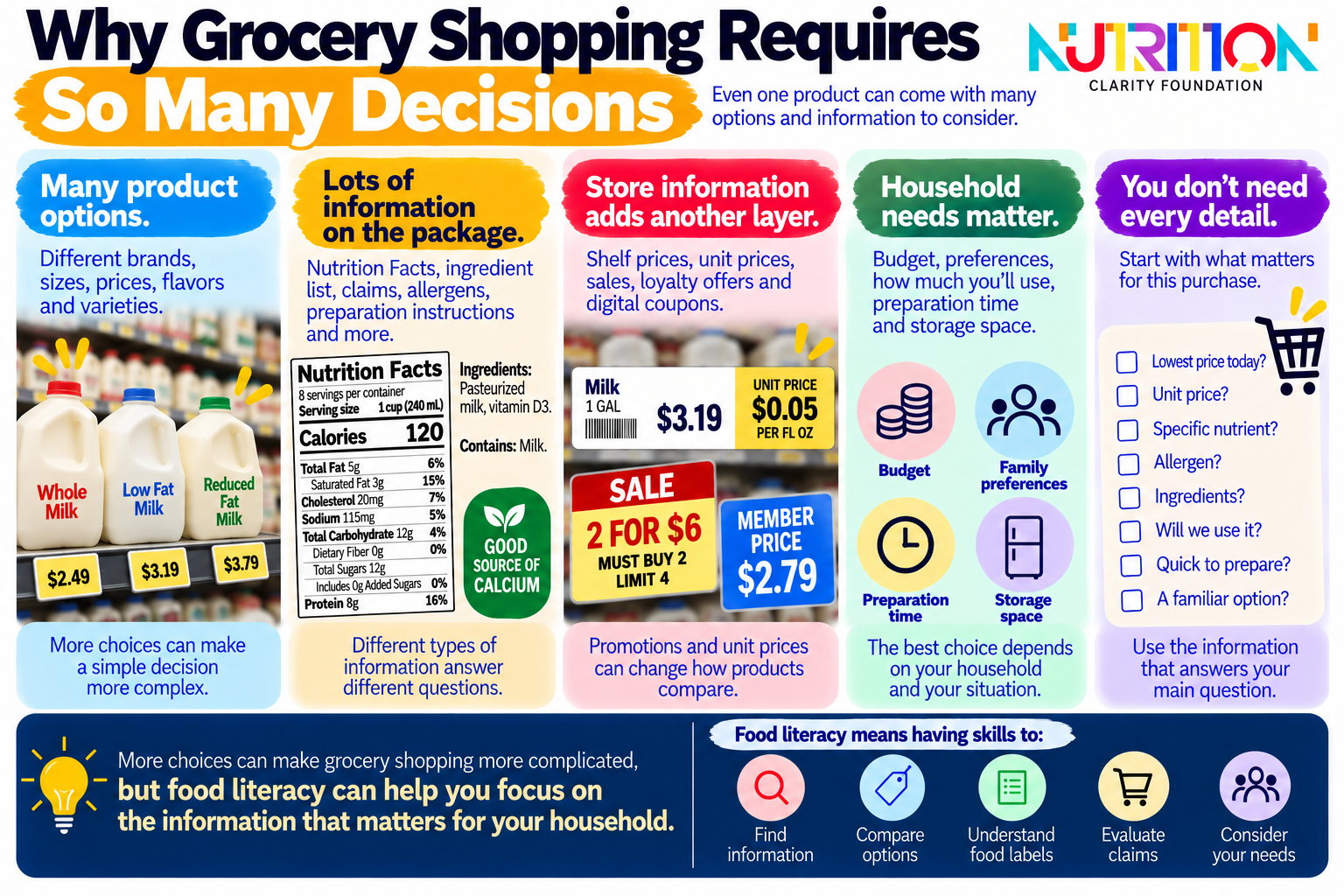
Walk into a grocery store for one simple item and you may find an entire shelf of options.
Different brands.
Different sizes.
Different prices.
Different ingredients.
Different nutrition information.
Different claims.
Different flavors.
Then there are sales, loyalty prices, store brands, package sizes, unit prices, household preferences, and the question of what you actually came to buy.
That’s a lot of information surrounding what may seem like a simple decision.
Grocery shopping isn’t just picking food from a shelf. It’s a series of decisions made within a particular budget, household, schedule, and set of priorities.
Understanding that can help explain why shopping sometimes feels like more work than expected.
One Product Can Involve Several Decisions
Imagine you’re buying bread.
At first, the decision sounds simple.
You need bread.
Then you reach the aisle.
One loaf costs less.
Another is on sale.
One package is larger.
Someone in your household prefers a particular brand.
One product has a claim on the front that catches your attention.
Another has different nutrition information.
Now one decision has become several.
You might be thinking about:
Price: What does this cost?
Value: How much am I getting for the price?
Preference: Will my household eat it?
Nutrition: Is there something specific I want to compare?
Ingredients: What’s in it?
Quantity: Will we use the entire package?
Convenience: Does this work for what I’m planning?
Not every shopper will consider every question.
But the number of possible considerations adds up quickly.
Grocery Stores Contain a Lot of Information
Food packages communicate information in many ways.
There may be:
Nutrition Facts
ingredient lists
allergen information
package claims
brand messaging
serving information
preparation instructions
package quantities
front-of-package statements
Then the store adds another layer:
shelf prices
unit prices
sale tags
loyalty offers
digital coupons
promotional displays
Some information is regulated labeling.
Some is marketing.
Some helps with price comparison.
And each type of information answers a different question.
Part of food literacy is learning to recognize those differences.
You Don’t Need Every Piece of Information for Every Decision
Seeing all that information can create the feeling that you’re supposed to evaluate all of it.
You aren’t.
If you’re comparing price, you may only need the shelf price and package quantity.
If package sizes differ, unit price might help.
If you’re checking a particular nutrient, the Nutrition Facts label may be the useful place to look.
If you’re checking for a food allergen, allergen and ingredient information become especially important.
If you want to understand a front-of-package claim, you can look more closely at what that claim actually means.
The question you’re asking can help determine which information deserves your attention.
Familiar Products Reduce Some of the Work
This is one reason people often buy familiar products.
Familiarity can simplify decisions.
You already know the taste.
You know whether your household will use it.
You may know approximately what it costs.
You know how you prepare it.
You may not need to examine the package closely every time.
That doesn’t mean shoppers aren’t paying attention.
Routine itself can be a way of managing the number of decisions involved in everyday life.
Then something changes.
The price increases.
The product is unavailable.
The package size changes.
Someone in the household wants something different.
Suddenly, a decision that had become automatic requires attention again.
Household Preferences Add Another Layer
Food isn’t purchased for numbers on a label.
It’s purchased to be used.
That means the preferences of the people eating it matter.
A product can have the lowest unit price and still offer little household value if nobody wants to eat it.
A different option may cost slightly more while fitting the household better.
Families may also be balancing several preferences at once.
One child likes one thing.
Another likes something else.
An adult may have a different priority.
Cultural traditions or familiar foods may matter.
Meals may need to work across different schedules.
The household context becomes part of the grocery decision.
Budget Decisions Happen Across the Whole Cart
A grocery budget isn’t usually spent on one item.
Each purchase exists alongside everything else that needs to go into the cart.
Spending an additional $2 on one product may seem small.
But shoppers are making those decisions repeatedly.
A dollar here.
Fifty cents there.
A sale on one product.
A price increase on another.
A larger package that costs more today but may last longer.
A smaller package that leaves more money available for another item.
The value of one decision can depend partly on what else the household needs.
Time Changes How Much Comparing Is Realistic
In theory, someone could compare every price, ingredient list, unit price, nutrition label, and promotion.
In everyday life, people have limited time.
A grocery trip may happen:
after work,
with children,
between appointments,
during a lunch break,
before catching a bus,
or while thinking about everything else that needs to happen that day.
Food literacy shouldn’t require turning every grocery trip into an investigation.
Useful skills should help people identify information more efficiently.
Marketing Adds to the Decision Environment
Food packages are also designed to attract attention.
Words, images, colors, claims, and package design can highlight certain features of a product.
You may see phrases related to:
nutrients
ingredients
production methods
taste
convenience
lifestyle
product characteristics
Some claims have specific regulatory definitions or requirements.
Others may communicate broader marketing messages.
Recognizing that front-of-package information is only one part of the package can help.
If a statement matters to your decision, you can look further.
The Nutrition Facts label and ingredient list may provide additional information.
More Choices Don’t Always Make the Decision Easier
Having options can be useful.
It gives shoppers the ability to consider price, preference, package size, ingredients, convenience, and other priorities.
At the same time, more options create more possible comparisons.
Five versions of a product mean more decisions than one.
Twenty versions create even more.
Food literacy doesn’t remove those options.
It can provide a way to navigate them.
Instead of asking:
“Which one is the best?”
you can ask:
“What matters for this purchase?”
That is often a much easier question to answer.
A Simple Question Can Narrow the Aisle
When a decision starts feeling complicated, begin with your priority.
Maybe it’s:
I need the lowest shelf price today.
I want to compare the unit price.
I need a package my household can finish.
I’m checking for a specific allergen.
I want to compare sodium.
I need something that takes very little time to prepare.
I want something my household already knows it likes.
Once you know the question, you don’t have to treat every piece of information as equally important.
Food Literacy Can Reduce the Guesswork
Food literacy doesn’t mean knowing everything about food.
It doesn’t mean carefully analyzing every package.
And it doesn’t mean making the same decisions as someone else.
It means building skills that help you find and understand useful information when you need it.
You can learn where to find serving information.
How to use % Daily Value.
How ingredient lists are organized.
How to compare unit prices.
How to recognize when package size affects value.
How to investigate an unfamiliar claim.
Then those tools are available when a grocery decision calls for them.
You Don’t Have to Solve the Entire Grocery Store
There will always be more information available than you need for one shopping trip.
The point isn’t to process all of it.
It’s to know how to find the information connected to the decision you’re making.
Some purchases may take seconds.
Others may deserve a closer comparison.
Both are normal.
Grocery shopping requires many decisions because food exists within real life—budgets, households, preferences, time, access, culture, and changing circumstances.
Food literacy can make those decisions more understandable without requiring every one of them to become complicated.
Sometimes knowing what you don’t need to compare is just as useful as knowing what you do.
Nutrition Clarity Takeaway
Continue Learning with Nutrition Clarity Foundation
Food decisions are part of everyday life. Explore practical, easy-to-understand resources designed to help you better understand food information and make informed decisions with greater confidence.