Walk through almost any grocery store and you’ll probably see the word “natural.”
It may appear on snacks, beverages, sauces, cereals, frozen foods, and many other packaged products.
The word can sound meaningful.
But what does it actually tell you about the food?
The answer is more limited than many shoppers might expect.
How Does the FDA Approach the Word “Natural”?
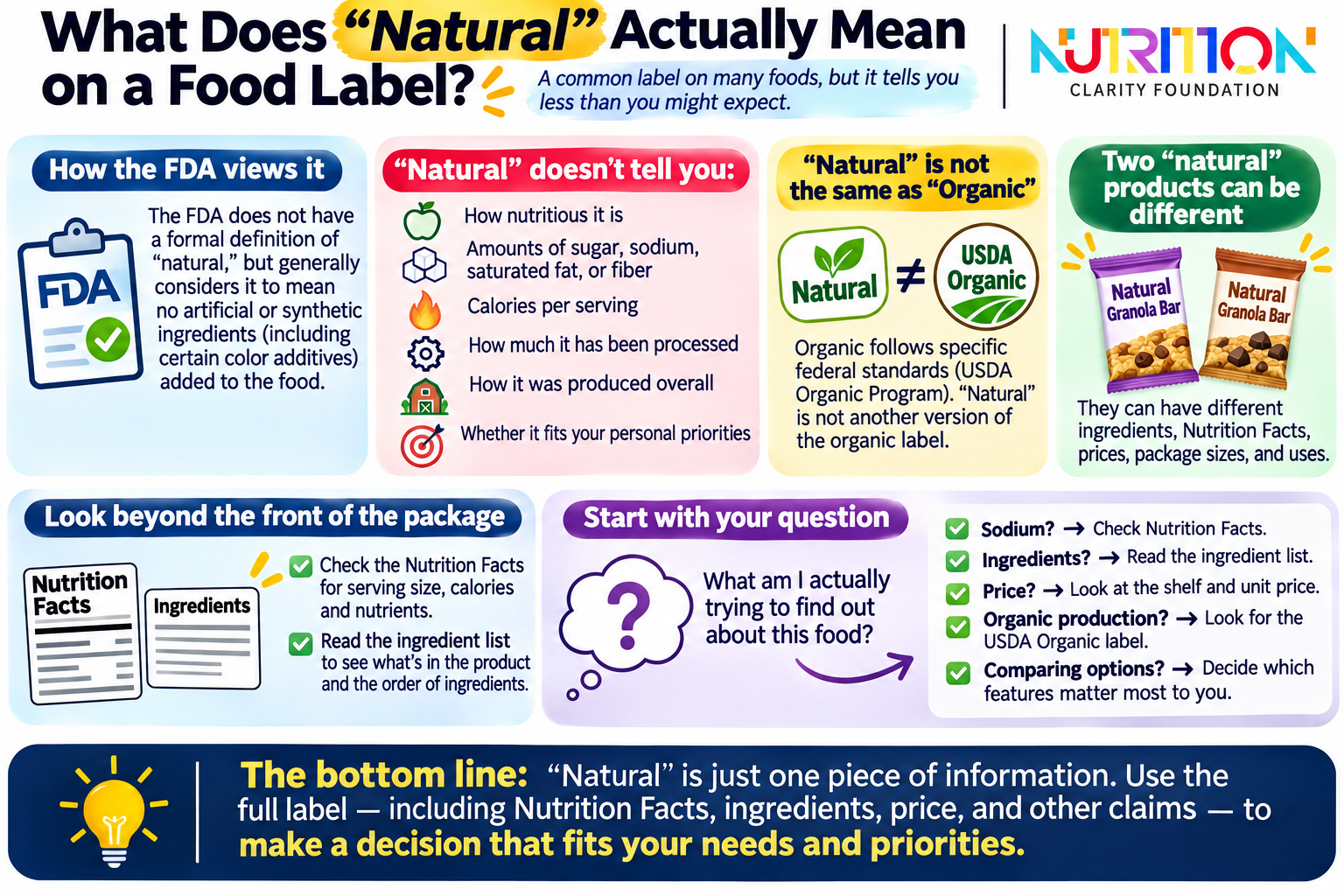
The U.S. Food and Drug Administration has not established a formal regulatory definition of “natural” for food labeling.
The agency has, however, maintained a longstanding policy concerning how the term is used.
Generally, the FDA has considered “natural” to mean that nothing artificial or synthetic—including certain color additives—has been included in or added to a food that would not normally be expected to be there.
That gives the word some context.
It also leaves many questions unanswered.
What “Natural” Doesn’t Necessarily Tell You
Seeing “natural” on a package doesn’t automatically tell you:
how nutritious the product is
how much sugar, sodium, saturated fat, or fiber it contains
how many calories are in a serving
how the ingredients compare with another product
how much the product has been processed
how the food was produced or manufactured overall
whether the product fits your personal priorities
In fact, the FDA has specifically noted that its longstanding policy on “natural” was not intended to address food-production methods, processing techniques, or whether the term implies a particular nutritional or health benefit.
That distinction is important.
A word on the front of a package can communicate something about a product without telling you everything about it.
“Natural” Is Not the Same as “Organic”
These two terms can easily sound like they belong in the same category.
They don’t mean the same thing.
Organic is connected to specific federal standards administered through the U.S. Department of Agriculture’s National Organic Program.
Those standards address how agricultural products are produced, handled, and labeled.
“Natural” does not function as another version of the USDA Organic label.
So a product labeled “natural” should not automatically be interpreted as organic.
Look Beyond the Front of the Package
Front-of-package language is designed to be noticed quickly.
Words, images, colors, and claims can influence what stands out when you’re looking at a shelf full of products.
That doesn’t mean you need to ignore everything on the front.
It means the front is only one source of information.
If you want to understand more about a packaged food, you can turn it around.
The Nutrition Facts label can provide information about serving size, calories, and nutrients.
The ingredient list can show you which ingredients are present and the order in which they’re listed by weight.
Other regulated statements and labels may provide additional information depending on the product.
What you choose to look at can depend on what you’re trying to learn.
Start With the Question You’re Actually Trying to Answer
Instead of asking whether a product labeled “natural” is simply “good” or “bad,” it may be more useful to ask:
What am I actually trying to find out about this food?
If you’re interested in sodium, look at the Nutrition Facts label.
If you want to know what ingredients are used, look at the ingredient list.
If you’re comparing prices, look at the shelf price and unit price.
If organic production matters to you, look for the appropriate USDA Organic labeling.
If you’re comparing two similar products, decide which characteristics matter for that particular purchase.
This helps turn a broad marketing term into a more specific information question.
Two “Natural” Products Can Still Be Very Different
Imagine two products sitting next to each other on a shelf.
Both say “natural” on the front.
That doesn’t mean their ingredient lists are identical.
It doesn’t mean their Nutrition Facts are the same.
It doesn’t mean they cost the same amount, come in the same package size, or serve the same purpose in a household.
The shared word on the front doesn’t erase the differences between the products.
If those differences matter to you, you’ll need more information than the word “natural” alone provides.
Food Labels Contain Different Kinds of Information
Part of building food literacy is learning that not everything printed on a package serves the same purpose.
Some information is required by regulation.
Some claims must meet specific requirements.
Some language is used primarily to describe or market the product.
Understanding those differences can make a crowded food package easier to navigate.
You don’t have to analyze every word every time you shop.
You can simply learn where to look when a particular question matters to you.
Let the Information Help You Decide
The word “natural” may be one piece of information on a food package.
It doesn’t have to make the decision for you.
Knowing what the term does—and doesn’t—communicate gives you more context for interpreting what you’re seeing.
From there, you can decide whether you need additional information from the Nutrition Facts label, ingredient list, price, package size, or another part of the product.
That’s part of food literacy:
understanding the information in front of you well enough to decide which pieces actually matter for the decision you’re making.
Nutrition Clarity Takeaway
Continue Learning with Nutrition Clarity Foundation
Food decisions are part of everyday life. Explore practical, easy-to-understand resources designed to help you better understand food information and make informed decisions with greater confidence.